This is worth a listen.
Showing posts with label Paul Buchanan. Show all posts
Showing posts with label Paul Buchanan. Show all posts
Saturday, September 28, 2013


Tuesday, August 28, 2012
Flying a flag
Paul Buchanan writes on flags of convenience a subject I have some interest in.
" The Marshall Islands is not the only Pacific Island Forum member to be classified as a Flag of Convenience (FOC) state. The Cooks Islands, Kiribati, Tuvalu and Vanuatu offer FOCs. Vanuatu has 77 ships in its fleet, of which 72 are foreign owned (39 by Japan). Tuvalu has 80 ships, of which 63 are foreign owned (Tuvalu has just de-registered under US pressure 22 Iranian oil tankers that were re-flagged in order to avoid international sanctions; it also has a past history of flagging North Korean vessels involved in arms and drug smuggling). Kiribati has 43 flagged vessels, 31 of them foreign owned. The Cook Islands has over 50 FOC vessels. Tonga maintained an FOC fleet until 2002, when it halted its FOC registry after one of its flagged ships was found to be smuggling weapons from North Korea.
This highlights the problems of open registry. While many legitimate companies avail themselves of FOCs in order to reduce costs, increase their margins and decrease their liabilities, they are also the flag of choice for arms, drug and people smuggling as well as illegal fisheries. The problem is two-fold: In legitimate industries it allows for a “race to the bottom:” lowering of operational standards across the occupational strata (say, for example, in the inspection regimes of blue water fishing vessels or bulk chemical carriers). To this can be added corruption, whereby loose or nebulous regulatory standards imposed by FOCs are manipulated to the immediate benefit of those charged with enforcing rules and regulations. Worse yet, it facilitates criminal enterprise because of the incentive structures involved, and, as has been mentioned repeatedly in security circles, it makes real the possibility of seaborne unconventional acts of warfare."
There is considerable use of Foreign flagged vessels in the New Zealand fishing industry. The Oyang 75 shows some of the problems this creates. Ironically the Oyang company pays no tax here pays no ACC levies but New Zealand under law has had to make ACC payments and in some cases welfare benefits.
" Given these obvious flaws in an international regime that allows for state registration granting sovereignty without responsibility, one would assume that there are conventions and protocols to standardize registration and the awarding of flags across nations. The International Transport Workers Federation has lobbied to that effect for some time. But the reality is that there are no universal regulations or protocols governing seafaring registries. Nation-states can choose to be open or closed registry as they see fit. They can choose to model their registration requirements on those of other countries. The industries involved can and have developed their own regulatory standards and codes of conduct. But in no case do states or industries have an obligation have to accept universal norms—their compliance with such is voluntary. In other words, sovereignty and self-interest trumps international regulation.
This has very serious implications for the South Pacific. The sale of tokens of sovereignty has been a lucrative source of revenue for Pacific micro-states. The proliferation of Pacific-based FOCs has the potential to surpass these as moneymakers (and indeed, is doing so in the Marshall islands). The real problem is that most of the fishing fleets and mineral, gas and petroleum exploration vessels/rigs operating in the South Pacific are registered under FOCs. This includes vessels working relatively close to shore as well as those operating on the high seas."
With regard to the fishing industry that is changing the Government has given the New Zealand industry four years for the industry to get organised after that only New Zealand flagged vessels will be able to fish in New Zealand's EEZ ( exclusive economic zone )

" Loose regulations minimize legal and commercial risk over the short term. The chain of responsibility is long and compartmentalized so as to minimize the liability exposure of those vested in a FOC operation. Absent a uniform regulatory regime with real enforcement power, commercial interests seek to maximize immediate opportunities within the limits of their capabilities and self-imposed standards of conduct. Data about accidents and other maritime mishaps, particularly on the high seas, suggests that a majority of the vessels involved are registered under FOCs. That makes sense if for no other reason then the fact that FOCs comprise the majority of commercial vessels currently in operation."
Indeed the vessels fishing in New Zealand's EEZ have with justification been accused of modern day slavery.
" The proliferation of FOCs in the South Pacific means that for all intents and purposes there is an unregulated seafaring environment in the region’s blue water. This not only includes fishing vessels and cargo carriers transiting through the South Pacific, but also the new wave of shallow and deep-water seabed mineral exploration floating vessels. The potential for accidents and a variety of illegal behavior at sea therefore rises commensurate with the number of FOC vessels in use.
One way to address the potential problems inherent in FOC seafaring is to use regional organizations to standardize registration criteria among member states. The South Pacific has the Pacific Island Forum and the South Pacific Commission as well as a number of specialized sub-groupings already in place, and these organizations undertake a number of region-wide initiatives that require standards and code of conduct within specified policy areas. However, there are currently no protocols or standards regarding FOCs in place in any South Pacific regional organization. Neither the Pacific Plan or the Millennium Target Goals adopted by the Pacific Island Forum address the subjects of FOCs. More basically, even if there were measures in place regarding the standards and conduct of South-Pacific-flagged vessels, the regional monitoring and enforcement capability is very weak."
That is an excellent idea.
" The main obstacle to regional standardization of FOC registries in the South Pacific is the revenue generation that comes from the sale of tokens of sovereignty. Many Pacific Island Countries (PICs), especially micro-states such as Tuvalu, Nauru and the Marshall Islands, depend heavily on sovereign token sales for hard currency earnings. There is consequently a strong disincentive for them to agree to any move to standardize regulations governing the sale of sovereign tokens."
I guess we could link aid to compliance but apart from that New Zealand and Australia have no ability to alter the regional situation so it is unlikely to change. Also linking aid to anything is fairly dumb given China's likely reaction, just look at Fiji.
Until FOC registration requirements are standardized the growth of South Pacific FOC registered vessels will continue, as will the excesses and sub-standard practices associated with them. This raises the risk of a major maritime mishap over the long-term."
Agreed. This has the potential to make MV Rena look like a walk in the park. I recommend reading Paul's article in full over at 36 Parallel
Tuesday, August 14, 2012
Australia "The Lucky Country"
Paul Buchanan has an excellent post up about Australia emergence as a regional power on the same scale as Brazil, India and Russia. In fact he goes further to suggest the cousins might well become greater than these three of the four BRIC nations ( China as he points out is now in fact a super power and should not be classed alongside the other three ). Paul's summary below.
 The relationship with the US is already well-established and intimate. That poses a problem for Australia, which needs to be seen as an independent operator if is to be considered a legitimate middle power. Too much identification with the US can lead to it being perceived as a surrogate, proxy or instrument of the US, with all of the negative baggage that entails. Thus Australia has to exhibit some degree of foreign policy independence vis a vis the US in order to achieve its full potential. Where it chooses to do so is a matter of conjecture (climate change may be a start), but in any event it will require that it balance its pro-US security orientation with an economic and diplomatic approach to the PRC that is neither confrontational nor obsequious, and which bridges the strategic gap between its growing international security commitments and its increasing economic orientation towards the PRC and the rest of Asia. In the measure that it can achieve that balance, its reputation for independence will be enhanced and its rise to great power status advanced.
Go have a read it is fascinating to think of an Australia with a truly global reach.
Summary: When comparing Australia to other rising middle powers on a number of macro-characteristics, Australia is not sui generis. However, it has a number of unique traits and relationships that allow it to be compared favorably with countries such as Brazil, India and Russia. This has given Australia a larger footprint in international affairs than its location and population size otherwise would merit. Assuming that political dysfunctionalities will not intrude on the core functions of the national policy-making process, Australia has the potential to not only surpass the BRI countries in terms of global influence (which is one argument for it being awarded a Security Council seat), but to become a great power in its own right. Above all other factors, the key to doing so will require dedication and consistency in its approach to both proximate and distant factors: Indonesia and Melanesia close to home, and the PRC and the US further afield.
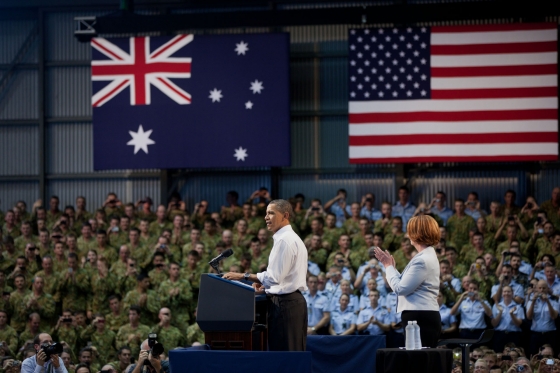 The relationship with the US is already well-established and intimate. That poses a problem for Australia, which needs to be seen as an independent operator if is to be considered a legitimate middle power. Too much identification with the US can lead to it being perceived as a surrogate, proxy or instrument of the US, with all of the negative baggage that entails. Thus Australia has to exhibit some degree of foreign policy independence vis a vis the US in order to achieve its full potential. Where it chooses to do so is a matter of conjecture (climate change may be a start), but in any event it will require that it balance its pro-US security orientation with an economic and diplomatic approach to the PRC that is neither confrontational nor obsequious, and which bridges the strategic gap between its growing international security commitments and its increasing economic orientation towards the PRC and the rest of Asia. In the measure that it can achieve that balance, its reputation for independence will be enhanced and its rise to great power status advanced.
Closer to home, the priorities for Australia in the near future are to continue to strengthen its neighborly relations with Indonesia so as to overcome past differences and solidify the security of its northern borders, and to “reboot” its approach to Melanesia and the larger Pacific in light of the changing realities affecting the region. Neither the paternalistic attitude of the past nor the softly-softly nature of more recent approaches to the Southwestern Pacific will suffice given the rise of Melanesia as a raw materials exporter with an increasingly independent orientation on the part of its member states and the entrance of newer extra-regional actors (both public and private) onto the scene. This will require the employment of an Australian version of “smart” power where it combines diplomatic, economic and security initiatives in order to re-align the regional balance in ways that are favorable to or at least neutral with regards to Australian interests and yet which reduces the historical levels of suspicion that have greeted many of its past regional forays. Neither the proximate or distant relationships are easily managed given the fluid nature of the current world moment, yet it is clear that they must be. It is in this regard that Australia’s strong institutionalism may be an advantage.
Futures Forecast: Australia will continue to rise as a middle power and, barring a collapse of commodity export markets or paralysis within the national party system, will establish itself as a Southern Hemisphere great power
Go have a read it is fascinating to think of an Australia with a truly global reach.
Subscribe to:
Posts (Atom)